Marketing Predictions for 2026: What We’re Seeing (and Betting On)
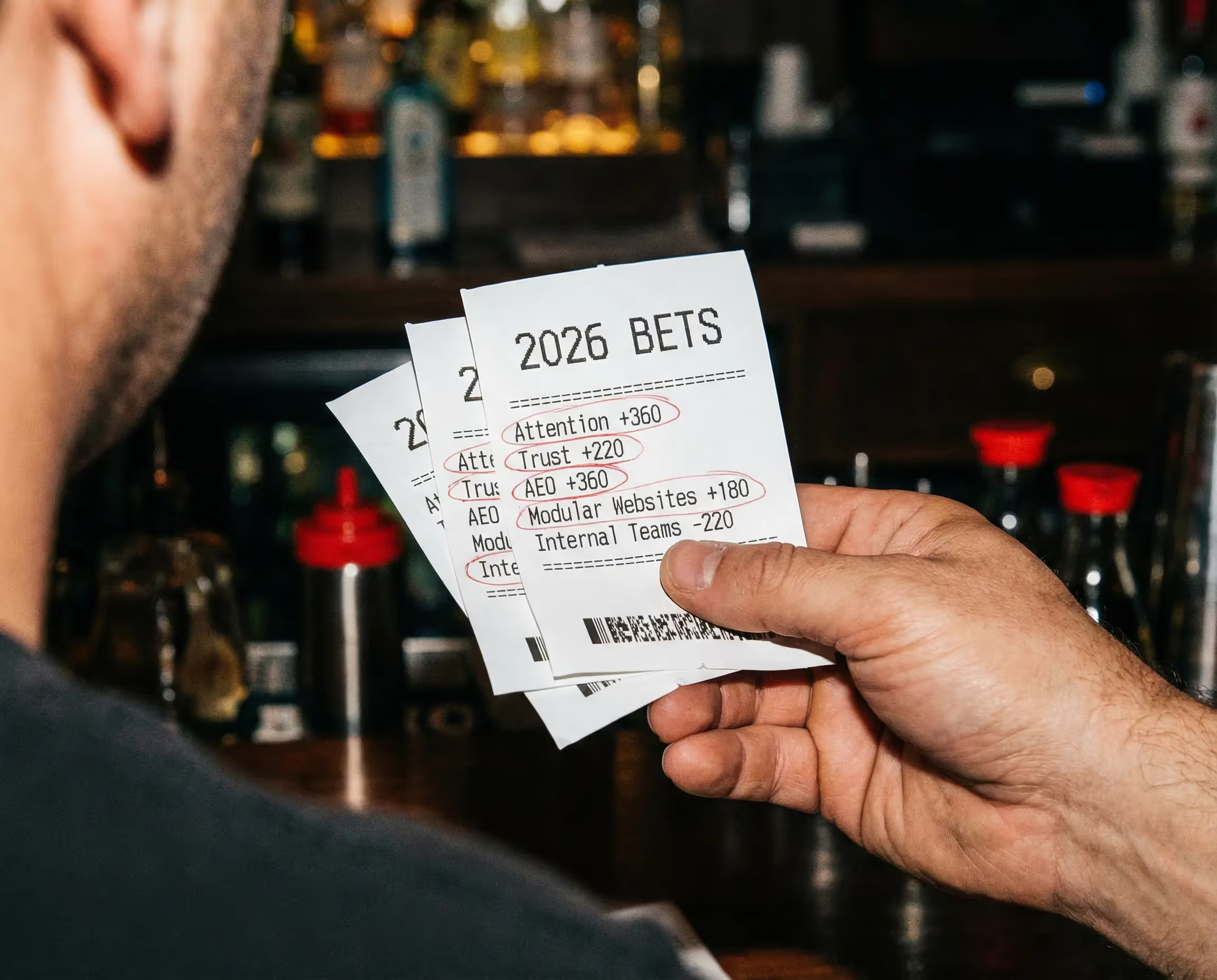
Marketing in 2026 isn’t about chasing trends or producing more content, it’s about building systems that earn attention, trust, and longevity. This article breaks down the shifts we’re already seeing, from attention becoming the only KPI that really matters, to trust and craft pushing back against AI sameness, and AEO starting to overtake traditional SEO. We look at why modular websites and flexible platforms are replacing big redesign cycles, how brand identity needs to adapt by platform, and why creative direction is becoming more valuable than execution. At the core is adaptability: lean teams supported by strong partners, owned digital platforms that enable speed, and brands built to respond to culture in real time, not months later.
Marketing Predictions for 2026: What We’re Seeing (and Betting On)
Every year comes with a fresh batch of “trends.” New tools, new platforms, new formats. Most of them look exciting for about six months and then quietly disappear.
The shifts that actually matter tend to be less flashy. They’re behavioral, fundamental, and underneath the trends and they usually show up in client conversations before they show up in headlines.
Looking ahead to 2026, these are the changes we’re already seeing take shape and the ones we think brands should be paying attention to now, instead of trying to catch up later.
Attention Becomes the Only KPI That Matters
Reach and impressions aren’t going away, but they’re becoming far less meaningful on their own. What brands are really chasing now is attention that lasts.
We’ve seen plenty of campaigns optimize for a conversion rate that drives a quick sale and absolutely nothing else. The customer buys once, forgets who you are, and never comes back. Sure, on paper it looks like a win but in reality it’s a leaky bucket.
Time spent, recall, saves, rewatches, repeat exposure. These are the signals that actually point to long-term growth. Sustained attention is what builds brand memory and brand memory is what drives lifetime value.
If someone remembers you six months later without being prompted, that’s worth more than a low-cost click that disappears in 30 seconds. In 2026, the brands that win will be the ones measuring interest, rather than just activity.
AEO Starts to Overtake SEO in Importance
SEO is not dead. It’s still foundational but it’s no longer the full picture.
What’s changing quickly is how people find answers. More and more users are asking questions directly to AI tools instead of opening a browser and clicking through ten links. Being the suggested app, platform, product, or service inside an LLM response is becoming just as important as ranking on page one.
We started seeing this shift in 2025. In 2026, we’re betting that this is going to double and start to eclipse traditional SEO.
Optimizing for answers means structuring your content clearly, writing in a way that solves real questions, and making it easy for AI systems to understand what you actually do and who you’re for. Clarity beats keyword density every time.
This doesn’t mean abandoning SEO but rather expanding your thinking. AEO and SEO should work together. The brands that start now have a real opportunity to establish authority before this space becomes saturated over the next couple of years.
Modular Websites Replace Big Redesign Cycles
We’ve seen too many companies spend tens of thousands of dollars on a website refresh, only to feel boxed in again two years later.
Unless you are a creative or web agency, you should not need to rebuild your website every two years.
Your site should be able to evolve with your business. New service offering? Add a section. New product line? Spin up pages without breaking everything else. A component-based, modular approach lets your site grow alongside your brand instead of holding it hostage.
Before starting any website build, talk to your agency or provider about how they plan for evolution, not just launch day. Long term strategy matters here and is often overlooked when needing a solution for today.
And a note to our web agency friends: yes, you absolutely should rebuild your site often. It’s your main portfolio piece and your first wow moment. A broken agency website is like a garage door company with a garage door that doesn’t work.
Creative Direction Becomes More Valuable Than Execution
Execution is getting faster and cheaper. AI has made sure of that.
What it hasn’t replaced is judgment.
Strong creative direction is what separates forgettable output from work that actually lands. The campaigns that outperform always have methodical thought behind them. Clear intent. Clear taste. Clear restraint (more on this in a later article).
This is also worth saying to any creatives feeling uncertain about the future. No matter how advanced the tools become, we will always need drivers, directors and people who can see the bigger picture and make decisions.
AI can assemble. It can generate. It cannot should not lead.
Brand Identity Stops Being One Thing
Yes, you still need brand guidelines. No, you should not redesign your logo because you “had a great idea” last night.
That said, your brand is allowed to live differently across platforms.
The same product and features can and should be told in different ways depending on the audience and context. The way your brand shows up on Facebook should not feel identical to how it shows up on TikTok.
Consistency matters, but rigidity hurts. Let your brand get playful where it makes sense and more serious where it needs to be. As long as everything feels like it comes from the same place, flexibility becomes a strength, not a risk.
Trust, Craft, and the Push Back on Generated Content
In a world flooded with AI-generated content, trust becomes the real growth engine.
As more brands lean on AI for speed and scale, audiences are getting better at sensing what’s real and what’s manufactured. Perfectly smooth visuals, overly clean copy, and “designed by algorithm” creative start to feel interchangeable. That sameness erodes trust, even when the execution looks good on paper.
What cuts through is craft.
We’re seeing brands lean into heritage, utility, and the tangible parts of their identity. The things that show human intent. Real photography over stock, texture over polish and process over promises. Think the brush strokes in a painting, the fingerprints in pottery, the saw marks in woodworking. These imperfections make brands feel honest and lived-in.
This is a long-term play, I’d go as far as saying it’s visual SEO. You can optimize and reduce in many areas of your business, but brand building should never be one of them. Trust compounds quietly over time and when it’s there, conversion becomes a byproduct rather than the only goal.
In 2026, the brands that stand out won’t be the ones producing the most content. They’ll be the ones willing to show their work, embrace their raw edges, and build something people actually believe in.
Video Production Splits in Two
The middle ground is disappearing.
For a long time, brands aimed for video that was “good enough.” Not overly polished, not too raw. In 2026, that space feels invisible. Content that sits in between rarely stands out and is easy to scroll past.
What we’re seeing instead is a clear split.
On one side, raw, phone-shot content wins on familiarity and frequency. It feels human, keeps brands present, and builds trust through consistency rather than perfection.
On the other, brands invest in fewer, more intentional cinematic pieces. Documentary-style videos and flagship brand content that live for years and help define the brand at a deeper level.
The best brands won’t pick one. They’ll use both together. High-production content builds credibility and narrative. Raw content keeps you relevant and top of mind. The mistake in 2026 won’t be choosing the wrong style, it will be creating video without a clear role in the bigger picture.
Website Platforms Beat Custom Builds for Most Brands
In 2026, your website can’t just be a brochure. It needs to be an active marketing surface. Something you can adjust, publish, and adapt quickly when opportunities show up.
Think of Oreo’s response during the Super Bowl blackout in 2013. That kind of agility only works if your systems allow it and while it’s easy to do on socials, you should be able to take it one step further and create a landing page or micro-site for that exact response or campaign
That kind of agility only works when your site isn’t locked behind long development cycles. Waiting weeks for a developer to change a page is no longer acceptable, being quick pays off.
For most SMB and mid-market brands, fully custom builds sound appealing but quickly become a bottleneck. Nobody wants to email a developer or agency, wait seven business days weeks, and pay a change request fee just to update a page. The brands that move fastest are the ones that can make changes themselves, test ideas, and respond while the moment is still relevant.
Platforms like Webflow win here because they prioritize speed, maintainability, and internal ownership. Custom development still has its place, and in fact the best solution should be a hybrid of the two, but for a lot of brands, being quick and flexible will outperform being technically impressive.
Your ability to react, adjust, and publish will pay off far more than having the most complex stack behind the scenes.
Lean Teams, Strong Partner Networks
Uncertainty across markets has made flexibility a priority, and brands are responding by rethinking how they build their teams.
Instead of stacking internal headcount, more companies are keeping their core teams lean and relying on external partners who can scale with them. Increasing hours, adding a new service, or testing a new channel through an agency is far easier and faster than searching for, hiring, onboarding, and managing a full-time employee. Especially when needs shift quarter to quarter.
This model also lowers risk. Brands can test what works before committing long term. If something gains traction, scale it. If it doesn’t, adjust or pull back without being locked into a role that no longer fits. That kind of adaptability is hard to achieve with a fixed internal structure.
Agencies are changing in this environment too. The best ones no longer act like task vendors. They operate as extensions of the internal team, bringing not just execution but systems, process, and strategic perspective. The relationship becomes less about deliverables and more about momentum.
At Alister, we often work our way out of a job. We help set up the foundations, workflows, and guardrails so that when it makes sense to hire internally, your new hire can actually focus on their craft instead of spending their days building SOPs or untangling messy processes. And let’s be honest, most creatives would much rather get better at what they do than manage systems all day.
That’s exactly why we built our Marketing Department in a Box offering. We saw firsthand that most teams don’t need one full-time skill set all year long. One month it’s video, the next it’s web updates, social content each month. Instead of hiring a single marketing manager and hoping they can cover all of it, this model gives you access to a full creative team that plugs into your business for roughly the same investment. You stay in control of the strategy, because you know your business best. We’re there to bring the marketing know-how, execution, and consistency across all the deliverables that actually move things forward.
In 2026, the brands that move fastest won’t be the ones with the biggest teams. They’ll be the ones built to adapt.